Bright-room buyer guide
Best UST Projector Screen for a Bright Room: Control Light in Three Layers
The strongest setup combines a capable projector, a UST-specific directional screen and basic room-light control.
Layer 1: reduce the worst light
Direct sun on the screen is difficult for any projection setup. Shades and fixture placement are not admissions of defeat; they are part of a high-performance bright-room system.
Layer 2: choose the optical structure
Use lenticular when wide seating and overhead-light rejection dominate. Compare Fresnel when the audience is centered and you want stronger directional rejection from more angles.
Layer 3: preserve projector brightness
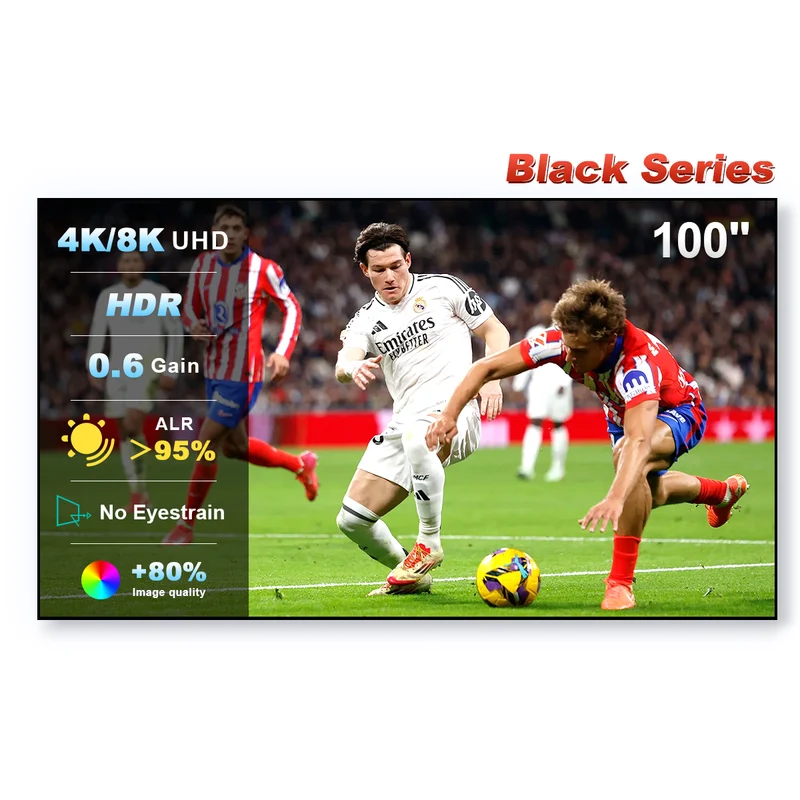
Screen size and gain change how much luminance reaches the viewer. A 0.6-gain screen on a huge image asks more of the projector than the same material at 100 inches.
Why the Black Series is a sensible bright-room shortlist
The Black Series is UST-specific, lenticular, manufacturer-rated at 95% ALR and 170° viewing, and independently received a best-value lenticular designation in a 2023 comparison.
Check Black Series current availability →
FAQ
What screen type is good for a bright UST room?
UST-specific ALR/CLR material is usually the starting point. Lenticular suits wide seating and overhead-light rejection; Fresnel can offer stronger directional control with a narrower viewing region.
Does a brighter projector remove the need for ALR?
No. More projector light can improve highlights, but ambient light still raises the black floor. Screen directionality and room-light control remain important.
Is the Black Series intended for bright rooms?
Yes. The merchant markets it for ambient-light environments and rates it at 95% ALR.
Keep researching
Research basis: Current Black Series manufacturer specs; The Hook Up 2023 UST screen comparison; editorial room-light guidance.