Research-based review
NothingProjector Black Series Review: Strong Value for a Bright-Room UST Setup?
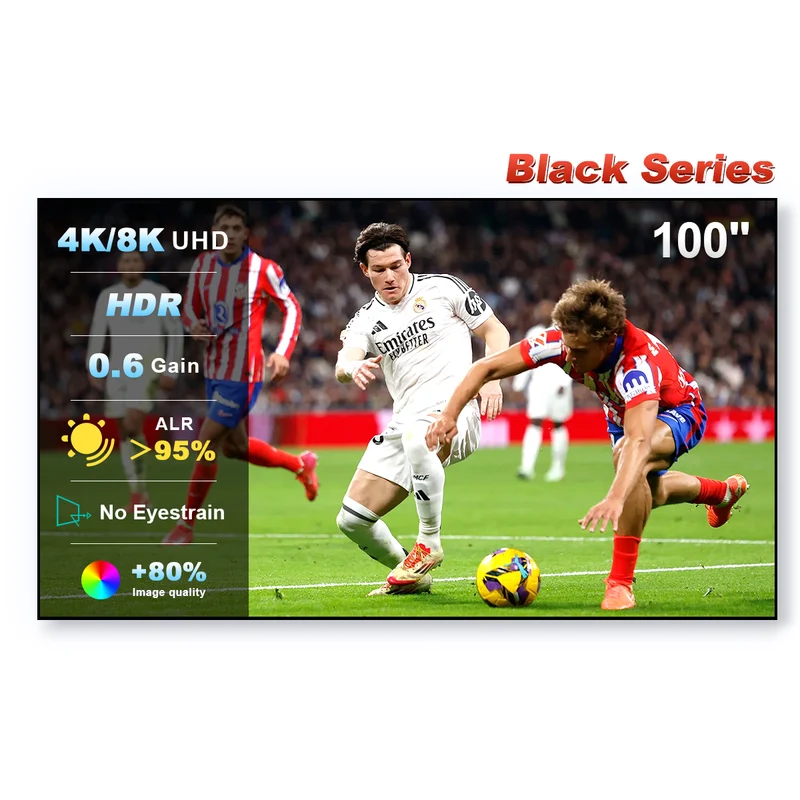
The Black Series is a fixed-frame, UST-oriented lenticular ALR/CLR screen. Its appeal is straightforward: wide-angle seating, low gain, aggressive ambient-light rejection claims and a size range broad enough for most living-room laser-TV installs.
| What matters | Black Series | Why it matters |
|---|---|---|
| Screen type | Lenticular ALR/CLR, fixed frame | Designed around UST light arriving from below. |
| Gain | 0.6 (manufacturer-rated) | Lower gain can support darker blacks and ambient-light control, but demands adequate projector brightness. |
| Ambient light rejection | 95% (manufacturer-rated) | Relevant for living rooms with ceiling light/daylight. |
| Viewing angle | 170° (manufacturer-rated) | Useful when seats spread across a room. |
| Sizes | 84–150 inches | Broad fixed-frame coverage; merchant notes larger sizes may be spliced. |
| Mount | Wall | Permanent installation; no roll-away mechanism. |
What the Black Series gets right
It matches the geometry of a UST projector
UST projectors send light upward at a steep angle. A lenticular screen uses a directional microstructure to favor that light while absorbing or redirecting a meaningful share of unwanted light arriving from above. That is fundamentally different from simply making a screen darker.
It gives you a wide seating strategy
The merchant rates the viewing angle at 170 degrees. That is one of the core reasons to look at lenticular material instead of a more directional Fresnel surface: it can be friendlier to sofas that extend well off center.
The independent value case is credible
The Hook Up's 2023 comparison tested eight UST screens across gain, black floor, ambient-light behavior, clarity and side-by-side image performance. In that specific test, the Nothing Projector fixed-frame screen advanced past cheaper lenticular options and was ultimately called the best-value top lenticular choice. That does not make it universally best; it does make the value proposition more than a merchant-only claim.
Trade-offs to understand before buying
0.6 gain is not automatically better
Lower gain can help a screen look darker when the projector is off and can support perceived contrast in ambient light. The other side of that trade-off is luminance. If your projector is relatively dim or you choose a very large screen, you should think about brightness headroom rather than treating a low gain number as a trophy.
Large sizes may use seams
The merchant currently notes that screens larger than 120 inches require a splicing process and therefore include a fine seam. If your goal is a seamless 130–150 inch surface, this is a decision point rather than a footnote.
Fixed frame means commitment
This product is wall mounted. That is excellent for flatness and repeatability, but not for a multipurpose room where the screen must disappear. In that case, a motorized floor-rising or drop-down UST screen belongs in a different comparison.
Who should buy it?
- Good fit: UST owners with ceiling light/daylight, a permanent wall, wide seating, and enough projector brightness for a 0.6-gain surface.
- Think twice: long-throw projector owners, renters who cannot mount a frame, viewers who need a retractable screen, or anyone assuming “95% ALR” means ambient light no longer matters.
- Compare first: centered-seat users choosing between lenticular and Fresnel, especially if maximum directional rejection matters more than wide viewing.
FAQ
Is the NothingProjector Black Series only for ultra-short-throw projectors?
The current merchant specification table identifies it as compatible with ultra-short-throw projectors. Do not assume a long-throw projector will work correctly with this UST-oriented lenticular structure.
What gain does the Black Series use?
NothingProjector currently lists 0.6 gain for the fixed-frame Black Series.
What sizes are available?
The current product page lists fixed-frame sizes from 84 inches through 150 inches, with larger sizes above 120 inches described as using a splicing process.
Has Projection Proof personally tested it?
No. This review is research-led and separates manufacturer specifications from attributed independent testing.
Keep researching
Research basis: NothingProjector Black Series product page and size table, checked 2026-09-15; The Hook Up, “Ultimate UST Projector Screen Comparison – 8 CLR/ALR Screens Tested and Reviewed,” published 2023-03-09.