Core concept
ALR vs CLR Screens: What UST Owners Actually Need to Know
The labels overlap. What matters is the optical structure and the direction of both projector light and room light.
ALR is the broad category
ALR means ambient light rejecting. The idea is to reflect useful projector light toward viewers while reducing some unwanted room light. Different materials accomplish that in different ways.
CLR is usually a UST-specific idea
CLR is commonly expanded as ceiling light rejecting. In UST installations, the projector sits below the image and fires upward. A lenticular “black grid” style surface can favor light from below while suppressing more light arriving from above.
Why long-throw ALR and UST ALR are not interchangeable
Long-throw ALR screens may be structured to favor light arriving from the back of the room. A UST projector approaches the screen at a far steeper angle. The wrong ALR material can reject the projector's light along with the room light.
Where the Black Series fits
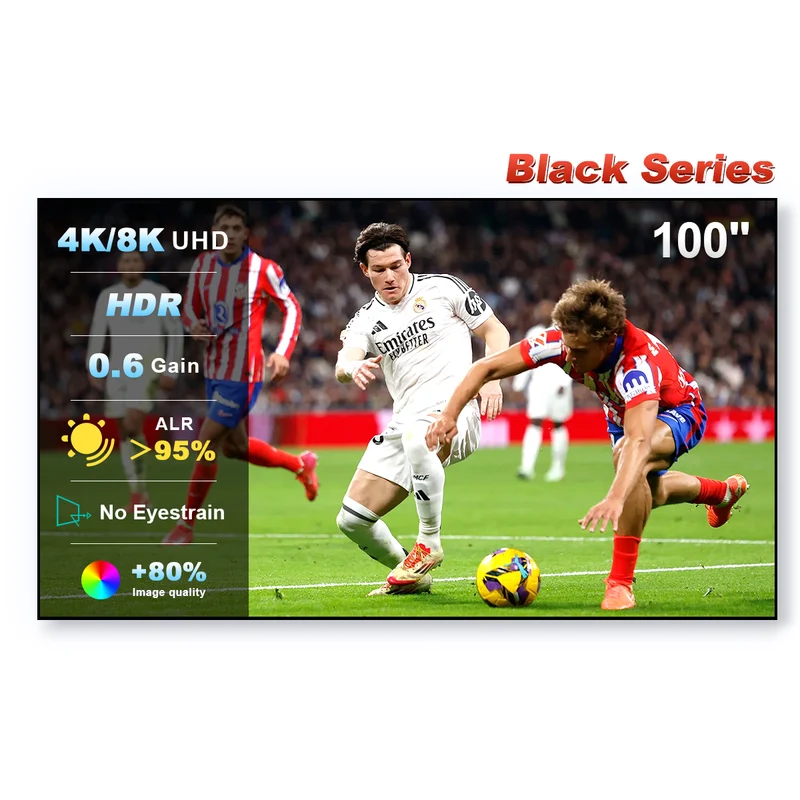
The NothingProjector Black Series is marketed as an ALR/CLR lenticular screen specifically for UST projectors. The manufacturer currently rates it at 0.6 gain, 95% ambient-light rejection and a 170° viewing angle.
See the Black Series UST screen →
FAQ
Is CLR different from ALR?
CLR is commonly used for ceiling-light-rejecting UST screen designs and can be treated as a UST-focused type within the broader ambient-light-rejecting category.
Can I use any ALR screen with a UST projector?
No. Long-throw ALR screens can have a different directional structure. Verify that the material is specifically intended for ultra-short-throw projection.
Does ALR work in a fully sunlit room?
ALR improves contrast by managing ambient light; it does not make projector brightness or room lighting irrelevant. Direct sunlight remains difficult.
Keep researching
Research basis: NothingProjector educational article “What is the different between ALR screen and CLR screen,” plus the Black Series product page; checked 2026-09-15.